 Thorchain
 Native Swaps, Liquidity Pools, and RUNE
Thorchain swaps native assets across supported blockchains through liquidity pools that pair each external asset with its native token, RUNE. Validators observe deposits and collectively sign payments from network vaults, allowing cross-chain settlement without requiring wrapped substitutes. Swaps change an asset holding, while liquidity provision supplies trading capital and bonding supplies the collateral that supports network security.
Table of contents
The network separates pricing, transaction observation, and vault signing. Those components support different ways to commit capital. A swap quote estimates an asset conversion, pool units track ownership, and a validator bond commits collateral.
RUNE pools, vaults, and consensus
RUNE links the liquidity pools, while validators coordinate the vaults that hold and transfer assets on connected chains. An automated market maker, or AMM, determines exchange prices from pool balances. Pools track pricing and ownership; vaults hold the native funds that back those balances. Thorchain uses the Cosmos SDK and CometBFT for its own blockchain. Its threshold signature scheme distributes signing responsibility across participating nodes, so routine signing doesn’t require any node to hold the complete vault key.
Arbitrage connects pool prices to external markets. Trading against a price difference changes pool balances and helps bring exchange rates closer together. Fees and available liquidity affect that adjustment. Threshold signing governs who can move vault funds; it doesn’t protect against every software defect. A vault-signing exploit on May 15, 2026 triggered a network halt. The network restarted on June 22 with the v3.19 security fixes. Funds that remain in pool or application positions retain protocol exposure beyond the duration of a single swap.
Pool routing and cross-chain settlement
Pool routing converts value through RUNE, while settlement connects an observed deposit to the requested payout on a supported chain. The network reads transaction instructions, commonly carried in a memo, to identify the operation and destination. A wallet or exchange interface constructs those instructions; the protocol applies its execution rules. Market swaps execute against available pool prices, subject to any trade limit. Where the network enables queued limit swaps, they can wait for the price condition until execution or expiry.
Settlement paths
Swaps involving RUNE
A swap involving RUNE uses the relevant asset pool directly. The pool exchanges the external asset for RUNE, or RUNE for that asset.
Swaps between external assets
A swap between supported external assets crosses the input asset’s pool and the destination asset’s pool. RUNE connects the pricing operations inside the protocol. Those operations don’t require a separate user-managed RUNE transfer, and they don’t create a liquidity-provider position.
Observation and outbound delivery
Source-chain confirmations and validator observations govern when Thorchain can process an incoming deposit. Execution changes pool balances, and outbound signing authorizes the destination-chain transfer. These are distinct states, even when an interface presents them as one swap. An inbound transaction identifier doesn’t establish successful delivery on the destination chain. The confirmed destination transfer establishes that the native-asset payout arrived.
Network pauses can affect different parts of that process. A signing halt can queue outgoing transfers while leaving observation active. Liquidity pauses can suspend pool additions and withdrawals independently of trading. Even an API’s halt flag can become stale during a consensus stop. Sending additional funds during a halt can increase exposure to delay; a chain’s presence in a menu doesn’t establish that trading is available.
What determines swap fees and waiting time?
Pool depth and transaction size influence swap fees, while chain confirmations, execution settings, and outbound scheduling influence completion time. Costs include source-chain gas, pool liquidity fees, destination delivery charges, and any affiliate fee that the interface includes. The slip-based component responds to trade size relative to pool depth. Applicable fee floors mean low price impact doesn’t necessarily produce a zero liquidity fee. Compare expected net output for the same input and execution settings; an isolated percentage excludes other charges.
Streaming swaps divide execution into sub-swaps. Spaced execution gives arbitrage time to rebalance pools and can reduce slip. That division happens internally, avoiding a new source-chain transfer for every sub-swap. With suitable advanced-queue settings, rapid streaming can execute several iterations within one block; spaced streaming introduces block intervals. Neither mode removes fee floors or guarantees a fixed completion time. Source confirmations, execution scheduling, outbound delays, and destination confirmation all contribute to the wait. Quote timing fields estimate the selected route’s duration under current network conditions.
Liquidity positions and pooled returns
Liquidity providers own a changing share of a pool, with exposure to RUNE and the paired asset. Symmetric deposits contribute equal values of both assets. Asymmetric deposits contribute one side or unequal values, with the resulting position still carrying paired-asset exposure. Deposit fees and slip can affect that starting position. Withdrawal options depend on the addresses and deposit mode associated with the position.
Pool units measure proportional ownership, so redemption returns a share of the pool’s balances at withdrawal. Trading and price changes alter the pool’s composition. Fees contribute to returns, while network reward allocation influences the income that reaches liquidity providers. Impermanent loss describes underperformance against holding the original assets separately; fee income may not offset it. The protocol’s former impermanent loss protection has ended.
RUNEPool gives native RUNE exposure to the aggregate performance of protocol-owned liquidity across eligible pools. Participants don’t select individual pools through this mechanism. Returns and losses reflect that wider position, including impermanent loss, and redemptions can return more or less RUNE than the contribution. A configured deposit-maturity requirement limits withdrawals. Reserve-backstop limits and deposit or withdrawal halts can also constrain access, giving RUNEPool different exit conditions from an ordinary pool position.
Bonding and validator accountability
Bonding commits RUNE to validator security, with risks and release conditions that differ from holding liquidity units. Validator nodes need a native RUNE bond to participate in the network. Bond providers that the node operator has approved can contribute to an operator’s bond and share rewards without running the node themselves. Misconduct can expose principal to slashing, while poor operational performance can reduce rewards. For an active node, unbonding requires leaving the active set and completing vault migration. The Incentive Pendulum adjusts reward allocation between security capital and liquidity, connecting their economic roles.
Wallet access and programmable liquidity
Wallets, web interfaces, and aggregators provide access to the underlying swap network, with their own asset coverage and settings. Bitcoin and Ethereum are connected networks, while usable routes depend on available pools and operational chain support. The destination must match the exact asset and chain, including whether the selected output is native or a token representation. An interface’s wallet connection options don’t determine which routes the protocol supports. Supported memoless methods reference previously registered instructions through a short reference or an encoded amount. Reference validity depends on expiry, usage limits, and relevant halt settings.
Thorchain also supports a programmable application layer using CosmWasm smart contracts. Rujira develops that application layer and its services. Secured Assets connect supported native deposits to transferable balances that applications can use. These balances represent shares of deposited assets, and redemption follows the applicable share ratio. They also support the Inter-Blockchain Communication (IBC) protocol. Contract behavior and application restrictions add dependencies alongside the base protocol’s vault security.
Trade Accounts support internal trading against deposited balances held in a network module. Secured Assets extend internal trading to transferable, contract-compatible holdings. Trade Account balances stay internal until an external-chain payout. Secured Assets can also move over IBC without redeeming the underlying native asset. This exposure differs from a completed native swap.
What changed after the THORFi suspension?
THORFi’s defaulted savings and lending liabilities entered restructuring through TCY, a separate native token that supports RUNE revenue distributions. The suspension began on January 23, 2025. TCY payouts depend on staking eligibility, accumulated network income, and distribution controls. The restructuring didn’t restore the original savings or lending agreement. Token value and revenue distributions don’t establish full recovery of a creditor’s debt. Those legacy products remain separate from base-layer swaps and Rujira’s application services.
Matching the commitment to the intended use
Before authorizing a swap, liquidity deposit, or bond, check the requirements for that operation.
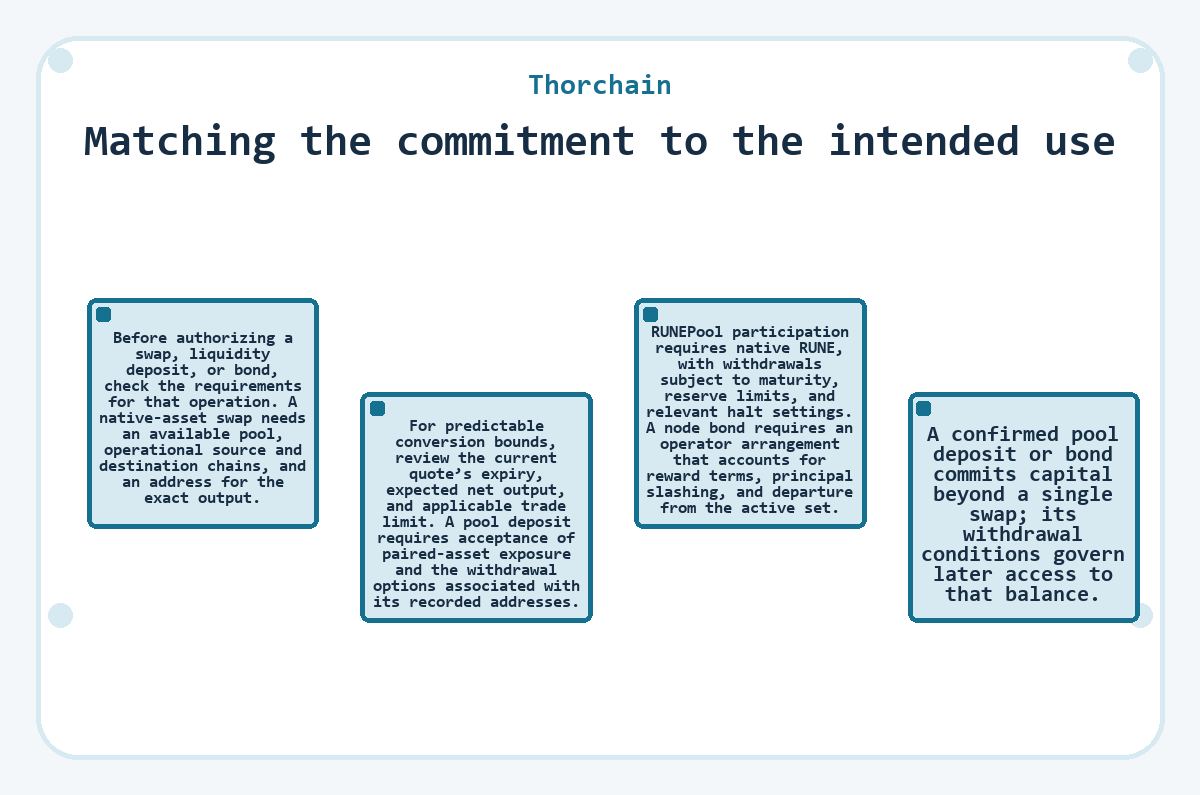
- A native-asset swap needs an available pool, operational source and destination chains, and an address for the exact output.
- For predictable conversion bounds, review the current quote’s expiry, expected net output, and applicable trade limit.
- A pool deposit requires acceptance of paired-asset exposure and the withdrawal options associated with its recorded addresses.
- RUNEPool participation requires native RUNE, with withdrawals subject to maturity, reserve limits, and relevant halt settings.
- A node bond requires an operator arrangement that accounts for reward terms, principal slashing, and departure from the active set.
A confirmed pool deposit or bond commits capital beyond a single swap; its withdrawal conditions govern later access to that balance.
Key questions about Thorchain
Do I need RUNE for a native-asset swap?
Swapping between supported external assets doesn’t require a separate RUNE balance. The protocol handles RUNE settlement internally. The incoming transfer carries its own source-chain fee, while destination delivery charges affect the swap output. Transactions made directly on the Thorchain blockchain have their own native RUNE fee requirements.
Does Thorchain require identity verification?
The protocol doesn’t require registration or identity verification for native swaps. A wallet, aggregator, or other interface can impose its own access conditions. Those interface requirements don’t change the protocol’s account-free design, and that design doesn’t make on-chain transaction history private.
Are all ERC-20 tokens supported when their chain is connected?
A connected chain doesn’t automatically make every ERC-20 token tradable. The specific token must have a usable pool and the correct chain-specific asset identity. An interface can expose only a subset of supported assets. Token names alone don’t establish that a route exists or that two representations are interchangeable.
What happens to the unfilled part of a streaming market swap?
When a streaming market swap finishes its attempts, the protocol sends successfully converted output and refunds the input that didn’t execute. If the first attempt fails, it refunds the whole stream without further attempts. Applicable outbound charges still apply. Streaming limit swaps have separate queue-persistence and expiration rules.
Will another RUNEPool deposit restart its withdrawal waiting period?
RUNEPool measures withdrawal maturity from the last deposit, so an additional deposit moves that starting point forward. The waiting period follows the configured block requirement, not a universal calendar duration. Reaching maturity doesn’t override withdrawal halts or reserve-backstop constraints.
Where does a failed swap’s refund go when the sender is a smart contract?
A refund normally returns to the original sending address, which can be a smart contract. A valid custom refund address in the transaction instructions can redirect it to the intended recipient. That address must support the inbound asset; an invalid custom address falls back to the sender.
How do node operators adjust network parameters?
Node operators use on-chain Mimir votes to change eligible network settings, including operational controls and configurable fees. Those changes differ from software upgrades, which require adoption of the relevant node software. Holding RUNE alone doesn’t give a wallet control over the network’s parameter settings.
Why can a small swap fail even when its pool is active?
A swap can be too small to cover delivery and potential refund costs even when the pool is available. The quote includes a recommended minimum input for the requested route. Source-chain dust thresholds are a separate constraint: the protocol ignores inbound transfers below the applicable threshold, so they don’t trigger a swap or an automatic refund.