 Thorchain
Thorchain bonding: RUNE collateral and node rewards
Thorchain bonding pledges native RUNE as collateral for a node that helps secure cross-chain transactions. The bond gives the network capital to penalize serious misconduct and gives an active node access to rewards. An operator runs the infrastructure; invited bond providers can supply part of its collateral without running that infrastructure themselves. Providers share the node’s earnings and exposure to penalties. Their RUNE enters the protocol’s bond module, and withdrawal depends on the node’s state.
Collateral connects node duties to financial consequences
A node’s bond backs its responsibility to validate the network and participate in observing and signing cross-chain transfers. The operator maintains the services that perform those duties. Providers contribute capital to the same node account, so the protocol evaluates the node’s combined bond. Adding providers changes who supplies the collateral; it doesn’t divide the node into separate validators. A provider keeps the private keys that authorize their account’s transactions, while the protocol holds the collateral. Those keys don’t make bonded funds freely spendable.
Bonded RUNE resides in the network’s bond module. Withdrawal follows protocol conditions, and the operator’s performance and departure affect providers who supply its collateral.
Provider admission before a bond deposit
If the operator hasn’t whitelisted your native address for the pooled node, obtain admission before sending collateral. A node in Ready status rejects added bond, and a network bonding pause can block deposits. Before funding, establish the operator fee and exit arrangement. The provider can then choose a contribution while leaving enough unbonded RUNE to cover the network transaction fee.
| Contribution stage | Who controls the RUNE or permission |
|---|---|
| Provider admission | The operator whitelists the provider’s address; the provider retains the wallet keys and uncommitted RUNE. |
| Authorized bond deposit | The provider signs a native RUNE deposit with a BOND memo identifying the node; the protocol receives the collateral. |
| Recorded provider allocation | The node’s bond-provider record attributes the contribution to the provider; protocol withdrawal rules govern its release. |
After successful processing, the provider’s recorded bond increases on the selected node. Match the provider address, credited contribution, and node address to the intended position; a transaction identifier alone doesn’t establish that credit.
With the same contribution and gross reward allocation, a higher operator fee leaves less reward for providers. Changing that fee changes expected proceeds without changing the RUNE that the provider chose to deposit.
Active status determines reward eligibility
A funded node earns validator rewards when it enters the active set, so a successful deposit doesn’t itself establish reward eligibility. Standby and Ready describe different stages before participation. Ready means the node meets entry requirements, while Active means it participates in the network. An eligible provider can also add bond to an active node, subject to bonding pauses and any configured maximum. Adding collateral doesn’t unlock an existing bond.
Node minimums and competition for entry
The protocol’s minimum node bond applies to the node’s total collateral, rather than requiring every invited provider to supply that entire amount. A pooled node combines the operator’s contribution with its providers’ contributions. The MinimumBondInRune setting establishes the lower bound for entry consideration. An operator may also set a contribution requirement for their own arrangements. That requirement is separate from the protocol’s node minimum.
Meeting the minimum doesn’t guarantee selection at the next churn, the event that rotates validator membership. Eligible nodes compete for entry, and bond size matters alongside the node’s operational readiness. The active and standby bond distribution therefore gives context that the minimum alone can’t provide. A provider funding a waiting node takes exposure before that node starts earning active-validator rewards. More capital can’t repair an unsynchronized service or another failed readiness requirement.
Does a larger bond always earn more?
A larger bond doesn’t always earn more because the protocol caps the bond amount that increases a node’s reward weight. RUNE bonded above a node’s effective reward cap doesn’t increase that node’s bond-based rewards. The bondHardCap metric describes this economic boundary. It differs from a configured maximum that can reject an oversized deposit. Additional collateral above the reward cap still enters the node’s total bond, potentially diluting providers’ returns per bonded RUNE.
Operator fees shape each provider’s reward share
A provider’s net earnings depend on the node’s rewards, the operator fee, and their share of its bond. Swap fees and reserve-funded block rewards supply income that the protocol allocates to nodes under its economic rules. The network transaction fee is a separate cost of submitting an operation. Operators also pay infrastructure costs, including the resources that connected-chain services require. Their commission compensates that work, but the commission percentage doesn’t establish a fixed return for providers.
Allocation within a pooled node
The operator fee comes out of the node’s reward before the protocol divides the remaining reward among bond providers. That allocation follows each provider’s bond share. An advertised node-level yield therefore needs context: the provider’s allocation follows the commission deduction and reflects the node’s reward eligibility and performance.
The operator payment
The operator receives its fee at reward distribution. The fee applies to rewards, rather than acting as a commission on the provider’s deposited principal. Operators can change their fee through an authorized transaction. A prior agreement or an old interface display doesn’t freeze the on-chain setting, so an expected reward share needs the fee that actually applies.
The provider allocation
Ordinary provider rewards increase the provider’s recorded bond, adding collateral that remains subject to bond rules. Compounding increases the position in RUNE; it doesn’t put that increase into the wallet’s spendable balance. An annualized yield display summarizes changing earnings. It doesn’t fix future swap activity, reward allocation, or the operator’s performance.
Payouts from future rewards
Bond Yield supports automatic payouts from future provider rewards only when the network enables BondYieldEnabled. A provider’s BONDYIELD configuration selects the share to pay at reward distribution, with the remainder added to bond. Configuring this option doesn’t withdraw existing collateral or release rewards that have already joined the bond. Without an active payout configuration, the normal full-rebond treatment applies.
When can bonded RUNE return to a wallet?
Bonded RUNE can normally return through UNBOND when the node is on Standby, has cleared the applicable lockup, and no longer belongs to a retiring vault. Active and Ready nodes don’t permit withdrawal of bonded funds. The PauseUnbond setting can also stop unbonding. The next scheduled churn doesn’t guarantee that a particular node will leave or complete its obligations.
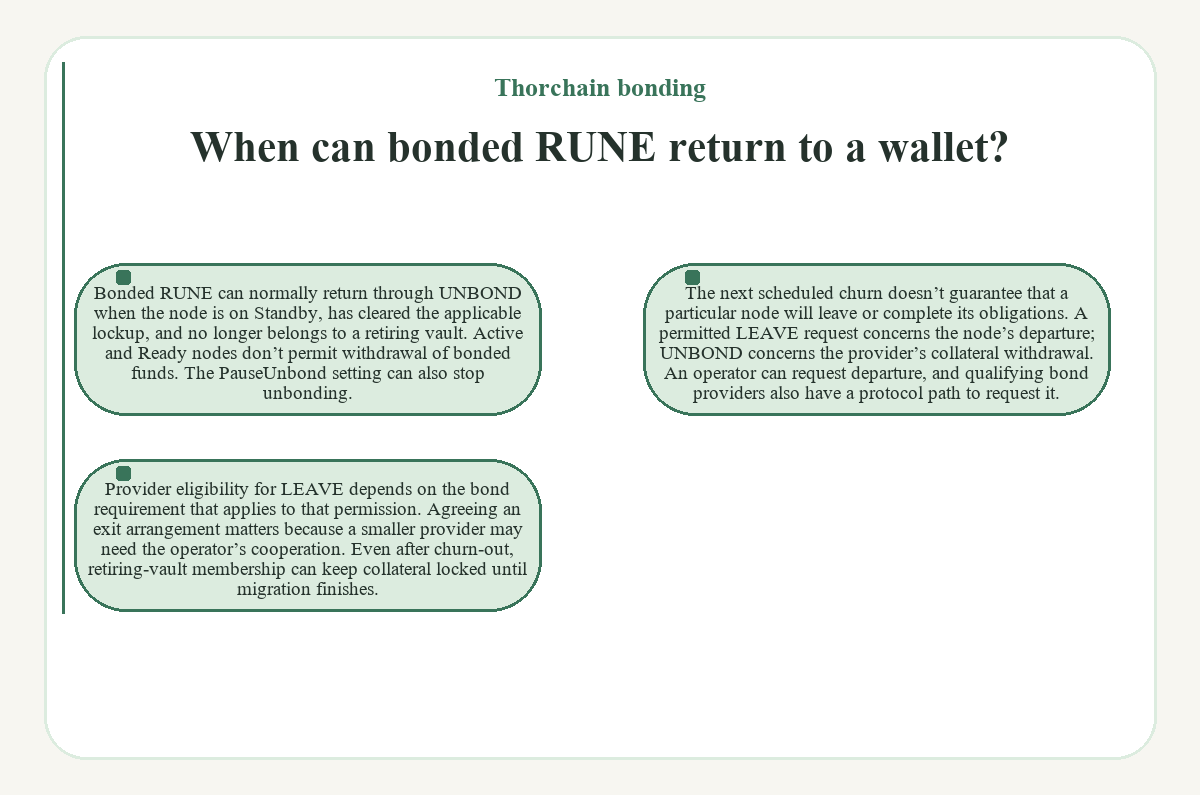
A permitted LEAVE request concerns the node’s departure; UNBOND concerns the provider’s collateral withdrawal. An operator can request departure, and qualifying bond providers also have a protocol path to request it. Provider eligibility for LEAVE depends on the bond requirement that applies to that permission. Agreeing an exit arrangement matters because a smaller provider may need the operator’s cooperation. Even after churn-out, retiring-vault membership can keep collateral locked until migration finishes.
Reward penalties differ from losses of collateral
A node’s operational failures can reduce reward earnings, while bond slashing can reduce recoverable collateral. Providers bear these economic effects even when another party operates the servers.
Missed observations and signing duties
Operational slash points reduce a node’s reward entitlement. Missed observations and failures to sign requested transactions can generate these penalties. A slash-point total therefore describes performance pressure on earnings. It isn’t itself an amount of RUNE removed from the provider’s principal, and an isolated total needs the node’s activity and reward period for context.
Principal exposed to serious misconduct
Unauthorized vault transfers and double signing can trigger bond slashing. The node’s pooled collateral supplies the economic backing, so providing funds without operating the node doesn’t shield them from that risk. RUNE’s market value can also change while withdrawal remains unavailable. A growing token balance and a falling market value can occur together; bond rewards don’t remove that price exposure.
Provider keys and public bond records
The provider’s private key authorizes bond-management transactions, while the operator’s key controls operator actions such as provider admission and fee changes. An operator needs the provider’s public address to invite them, not their seed phrase. Losing access to the provider account can prevent the provider from authorizing their own withdrawal. Sharing its private key would give another party that authority.
Node records expose operational details such as status, total bond, provider allocations, operator fee, and slash points. Bond transactions and allocations are public on-chain data. Keeping signing keys private doesn’t conceal those financial records.
Direct bonding and contract-managed exposure
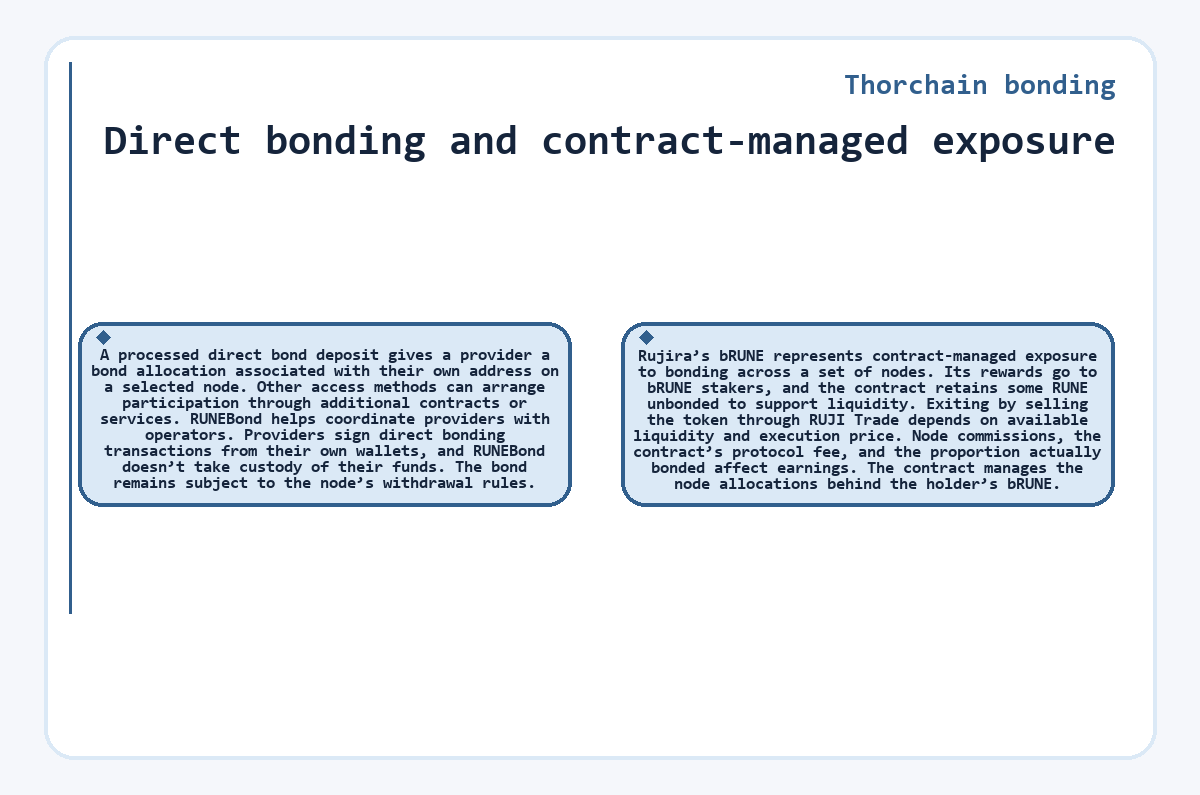
A processed direct bond deposit gives a provider a bond allocation associated with their own address on a selected node. Other access methods can arrange participation through additional contracts or services. RUNEBond helps coordinate providers with operators. Providers sign direct bonding transactions from their own wallets, and RUNEBond doesn’t take custody of their funds. The bond remains subject to the node’s withdrawal rules.
Rujira’s bRUNE represents contract-managed exposure to bonding across a set of nodes. Its rewards go to bRUNE stakers, and the contract retains some RUNE unbonded to support liquidity. Exiting by selling the token through RUJI Trade depends on available liquidity and execution price. Node commissions, the contract’s protocol fee, and the proportion actually bonded affect earnings. The contract manages the node allocations behind the holder’s bRUNE.
Thorchain bonding: reader questions
Can wrapped RUNE fund a native node bond?
Native node bonding requires native RUNE on Thorchain. A representation of RUNE on another blockchain isn’t the bond transaction’s accepted collateral. Holding a token with the same ticker therefore doesn’t establish compatibility; the asset and network must match the native bond operation.
Why does an UNBOND memo require such a large integer?
The raw UNBOND amount uses base units, with 1 RUNE equal to 100,000,000 units. A wallet may accept a human-readable RUNE amount and perform that conversion itself. The memo’s integer and the wallet’s displayed quantity therefore need different formatting, even when they describe the same withdrawal.
Can I move a bond to a new address without leaving the node?
REBOND can move bonded RUNE to another whitelisted address on the same node without withdrawing it. The destination must already have provider permission for that node, and the node cannot be in the Unknown state. This changes the address that owns the allocation, rather than creating spendable wallet funds.
Does bonding to a node give me a governance vote?
Contributing as a bond provider doesn’t give the provider a node operator’s governance vote. Operator voting authority belongs to the validator role, so a provider’s reward share doesn’t translate into a corresponding voting share, even when the provider supplies a substantial portion of the node’s collateral.
Is a partial unbond enough to remove my provider address?
A partial unbond doesn’t automatically remove a funded provider from the node’s whitelist. Operator-initiated removal requires the provider’s bond balance to reach zero. A provider can therefore retain permission after withdrawing only part of the contribution; permission and the amount still bonded are separate pieces of state.
What happens if a Bond Yield payout fails?
If an enabled Bond Yield payout cannot complete, the protocol adds that reward amount back to the provider’s bond during the same reward distribution cycle. The fallback increases bonded collateral rather than the wallet balance, so the amount then follows the normal conditions for withdrawing bond.
Do I have to send more RUNE with an UNBOND request?
An UNBOND request must not include a non-zero coin amount. The requested withdrawal belongs in the memo, and the account still needs enough spendable RUNE for the network transaction fee. Sending additional collateral with the request doesn’t pay for release of the existing bond and can cause rejection.